Showing posts with label P's Journey. Show all posts

Saturday, June 2, 2018

When in doubt

Where we started: 

 Pearl was born with severe atypical bilateral clubfoot. Many children with feet like hers have underlying neuromuscular or connective tissue issues that are hard to pinpoint or the clubfoot is connected to another syndrome like tethered spinal cord. Pearl's gluteal cleft is asymetrical and we are waiting until she is about a year old to evaluate for possible tethered cord. Next week, we see a geneticist to evaluate whether or not we have a connective tissue disorder that could be connected to her feet. She has good range of motion and flexibility now, and I have no doubt the brace has played a vital role in that. The brace also continued to correct her feet after the casts came off following the tenotomy (heel cord release). We've monitored her progress with x-rays and photos. She sees a physical therapist each week who assesses her flexibility. Recently, I became concerned because the creases on the bottoms of her feet are persisting. I took her to the local orthopedist and he doesn't think she needs casts but he was concerned that she didn't have enough external rotation of her feet to properly stretch the Achilles tendon (relapses occur because the tendon gets too tight during growth spurts). He also commented that braces can't or aren't intended to correct feet only hold correction. He is correct to an extent. The traditional boots and bar brace does not correct feet. It was designed to hold correction made from casting the feet. The DTKAFO brace is different.

Venting Side bar: I gave him the technical paper on the brace, x-rays, pictures and contact information for Cunningham Prosthetic back in April. It is clear to me that he didn't look at any of that information and doesn't care. He suggested we switch to the traditional brace more than once in the 20 minutes we were in his office. I've heard of doctors reporting mothers to CPS for choosing not to use the traditional brace and babies being blacklisted from every orthopedist in a state for the same reason. Certain vendors of orthopedic braces are now refusing to sell components for alternative braces due to pressure from a handful of influential physicians. Progress is stifled by such resistance. A recent study indicates that baby feet adapt quickly to changes made by casts and that a week long casting period isn't necessary (they placed pressure sensors in the casts). The results indicate that casts could be applied over a shorter period of time, reducing treatment time from 2-3 months to about one month. The study also discussed how a brace could be designed to do the correction based on that information. When the researchers approached orthopedists in their country about it, they were dismissed. 
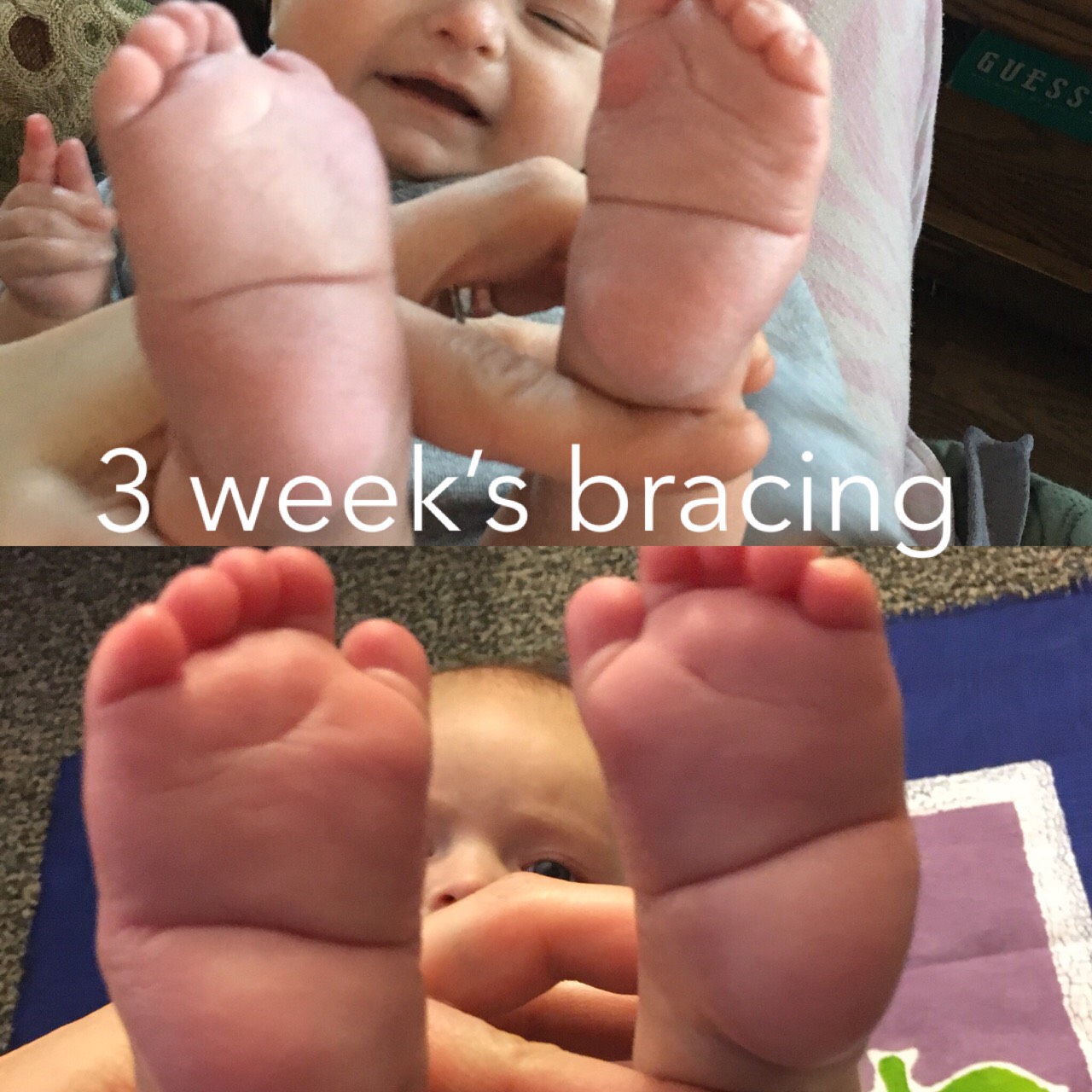

Progress and where we are now: Pearl started wearing braces in December 2017. After only 3 weeks we began to see improvement in her feet and it was clear that the braces were correcting her feet. We took x-rays at the beginning of bracing and after two months and will take them again soon. Those are discussed in a previous post. While the braces have helped, and other moms have told me feet like these are a process, I began to wonder if we'd reached a plateau with correction and talked to Jerald about making adjustments to the braces to help continue her progress. When I work on her feet I can stretch the plantar surfaces so that the bottoms of her feet become flat and the creases almost completely disappear. When she stands on them, they flatten out properly as well. Her heels are slowly dropping into place which is also a common issue with clubfoot babies. They often have "empty" heels because the bone that belongs in the hind foot is elevated inside the foot and out of position.

I asked Jerald if we could modify the foot bed to
 provide that plantar stretch while also adding more force to abduct her feet outward (think duck walking). We sent the braces via fedex on Wednesday and received them today. The foot bed has been modified to extend her feet outward and a wedge has been placed at the front of the foot bed to raise her metatarsals to stretch the bottom of her foot. The straps were modified to facilitate this stretch as well. We are taking the braces off every two hours to check for pressure points and red skin and to give her time to adjust to increased stretching and changes in sensations in her feet.

Why the status quo isn't good enough: There is no cure for clubfoot. It is caused by a change in the cellular structures of connective tissue, muscle fibers and how those tissues are enervated and receive blood and nutrients. Adults with clubfoot are more likely to develop arthritis and this is exacerbated by scar tissue from surgeries and lack of flexibility in the feet. Some adults experience such debilitating pain that they end up in wheel chairs or opt to amputate. The research on success rates in the traditional brace is skewed because they don't follow patients long enough, counting successes as no relapse up to age 5. In reality, children should be followed through puberty. I am certain Pearl would not have tolerated the traditional brace and she would not have the range of motion she has now if we used the static boots and bar. Stay tuned to see how the latest modifications to her braces make a difference.


Saturday, May 12, 2018

It takes a village: early interventions and clubfoot

Clubfoot is the most common birth defect, yet it is commonly misunderstood by practitioners and families caring for children with the condition. There is no cure for clubfeet. The deformity is caused by mutations in DNA that result in changes in how connective tissue, muscle fibers, fatty tissue, capillaries and nerve endings are laid down in the feet. Even after stretching casts and tenotomy, the anatomy of the foot predisposes it to changes in form and function. Studies indicate that the forces applied to feet during walking are distributed differently in clubfeet compared to normal feet. These changes in pressure distribution affect gait and how children stand (Pauk, J., Daunoraviciene, K., Ihnatouski, M., Griskevicius, J., & Raso, J., 2010).

The function of the foot impacts the biomechanics of the leg, knee and hip. Dysfunction in the foot can lead to lower limb, knee and upper limb/hip/lower back injury or pain (McClay, I., & Manal, K., 1997, Dananberg, H., & Guiliano, M., 1999). When clubfoot is treated, attention should be given to the entire leg and lower back. One of the reasons we decided to use the DTKAFO brace is because we believed the brace would be more ergonomic and would be an effective tool for treating the leg and foot system affected by the clubfoot deformity.

Any type of device that is used to support parts of our bodies can have a negative side effect of weakened muscles or compensation for lack of use by other parts of the body. Bracing wear time schedules for traditional braces and for the DTKAFO factor this in. It’s a fine balance between optimal brace time for maintaining correction and brace free time for muscle development and gross motor skill development. Pearl is struggling a little with reaching certain gross motor benchmarks. 

We are working with a physical therapist who taught us how to position Pearl when she is sitting to help her learn to transition into a crawling position. We practice this with the braces off and on. We also position her in standing positions, holding onto to sides of chest high boxes or toys both in her braces and out. We stretch and massage her feet and lower legs every day. An occupational therapist visits her every other week to monitor how Pearl uses her hands and wrists. We also used stretching and massage along with a splint to correct the deformity in her hands. Yesterday, we met with another occupational therapist who specializes in how babies and children eat. She taught us some strategies to help Pearl learn to eat properly. Pearl is struggling with how to use her tongue and mouth to push food back and swallow it.

All of these specialists come to our home or the daycare. In the US, the federal government allocates money for each state and territory to provide services to children with disabilities between the ages of 0-3. These early intervention services provide families with access to therapy, adaptive devices, and other services in the home or the daycare. This program is a powerful tool for helping children reach significant growth and development benchmarks. If the providers didn’t visit Pearl at home or at the day care, we would need to travel an hour each way to visit a therapist. This program removes barriers to access to care for many families.
\
In addition to the specialists we see through early intervention services, we Skype monthly with Jerald Cunningham, reviewing her progress in the DTKAFO brace. Last month, our physical therapist joined in on the call as well. Jerald is able to troubleshoot issues with the brace during these video calls. We’ve modified the brace twice via Skype call making adjustments specific to Pearl’s feet. Pearl’s teachers at the daycare are also a critical part of this team. They follow the therapy routines when Pearl is with them.

There are many uncertainties ahead of us. Pearl’s feet were under-corrected when we started bracing. The brace is correcting her feet, which a traditional brace cannot do. But the brace may only be able to correct her feet to a certain point and we will need further stretching casts or other interventions. Pearl may need speech therapy, she might also have a tethered spinal cord. Those two things we will revisit closer to her first birthday. In June, I will be evaluated by a geneticist to determine if Ehlers Danlos is also part of Pearl and my medical stories.

All of it can be overwhelming, worrying about her feet and a relapse, wondering if there are other underlying medical issues, stressing out about her being behind with some of her growth and developmental benchmarks, sticking to the stretching and massage routine even when exhausted. Our caseworker reminded us that Pearl has been through a lot already in her life and playing catch-up with reaching certain benchmarks is to be expected. I am grateful for the support we have from the specialists we work with, family, friends and other families who also have children with clubfoot. 


References: 

Dananberg, H. J., & Guiliano, M. (1999). Chronic low-back pain and its response to custom-made foot orthoses. Journal of the American Podiatric Medical Association, 89(3), 109-117.

McClay, I., & Manal, K. (1997). Coupling parameters in runners with normal and excessive pronation. Journal of Applied Biomechanics, 13(1), 109-124.

Pauk, J., Daunoraviciene, K., Ihnatouski, M., Griskevicius, J., & Raso, J. (2010). Analysis of the plantar pressure distribution in children with foot deformities. Acta Bioeng Biomech, 12(1), 29-34.

Friday, April 6, 2018

Finding Our Feet: Bracing progress and daily routines

 The other day, our orthopedist said the goal of clubfoot treatment is to get a functional foot that can  fit properly into a shoe without pain. He said, at this point we'd reached that goal and Pearl could comfortably wear shoes.

Shoes.....I donated all of her shoes after we learned she had clubfeet. I knew she'd be in casts until she was three months old and braces 23 hours a day until she is about 1 year old. And then she can wear shoes because bracing will only happen while she's sleeping. But even then, I wonder if we will use reverse last shoes, which are specifically made for children with orthopedic issues. I wore them for in-toeing when I was a toddler. These shoes will help keep her feet turned outward, one more intervention to hopefully prevent relapse.

We traveled half way across the US for her
casting, tenotomy and braces. Her feet came out of casts in December and I was heart broken when I saw them. I knew right then that her feet weren't fully corrected. Her feet are atypical and she is at greater risk for relapse and failed treatment. Traditionally, a child in her situation would have additional stretching casts and another tendon release. I asked if we could see if the brace could be modified to continue to correct her feet. While it isn't advisable to brace when feet are not fully corrected, we did it anyway. Ultimately it was our decision. The x-rays show that the brace is working! Her bones are aligning properly and there is less flexion in the mid foot. She still has creases on the bottom of her feet. I suspect those will be there for several years. But her feet are pliable and have great flexibility. When the braces were made, she had 5 degrees of dorsiflexion in her right foot and 0 in the left. She is now at a 12 in the right and 7-10 degrees in the left. The braces were modified to facilitate the realignment of her forefoot and mid foot so that the entire foot will position properly under the tibia.

She is learning to stand and starting to take her first steps in the braces and out of the braces. We see a physical therapist once a week and we do massage and stretching/exercises 3 times a day.


Saturday, December 16, 2017

It's a "process": When your feet are one in a million

  Pim was born with atypical bi-lateral club feet and a  left hand wrist contracture. Starting at about 3 weeks of age we started casting her feet using the Ponseti method and started splinting her wrist at night and massaging and stretching it several times a day. Right before Thanksgiving, Pim had a tenotomy on each foot and then was put in her last set of casts. On Monday of this past week, she had her casts removed and started wearing braces. 

Right before leaving for Maine to get her braces, I received a care package in the mail. One the items in the box was a batik of giraffes with long straight legs. My friend said the batik reminded her of Pim and our journey to treat her club feet. What is most appropriate about those giraffe is that club feet is not just about a foot deformity. It is a leg/ankle and foot deformity. The inward turning and rotating of the feet is caused by the Achilles tendon being too tight and short. Tendons attach muscle to bone. The Achilles attaches the calf muscle to the heel and provides the tension needed to be able to flex and
extend the foot at the ankle. People with club feet have different soft tissue and musculature than the general population. The tissue tends to be bunched up where the contractures form and is more fibrous. In addition, clubfeet have more slow twitch muscle fibers that are shorter in length. It is not uncommon to see less capillaries and nerve endings connected to the tissue as well. All of this lays a foundation for weaker muscles and resistance to change. Pim has atypical feet, which occurs in about 1 in a 1,000 club foot cases. Her feet are extremely resistant to correction. For every study done about club feet there are always statistics about children who relapse or need multiple surgeries and casts. Pim is one of those children. When we began reading the literature, we discovered that the traditional method of casting and boots and bar bracing didn't have guaranteed outcomes for kids like her.

Based on our understanding of club feet we decided we wanted to pursue a treatment plan that addressed her club feet as part of a series of anatomical dysfunctions and the foot/ankle/leg as a system. In addition to her feet turning inwards and being stuck in severe plantar flexion,
Pim's left tibia is rotated slightly and like other children with club feet, she has underdeveloped calf muscles and small, chunky feet. We are hoping for better outcomes long term, less surgical interventions and greater flexibility and pain free movement.

Over the course of three days, Pim's braces were custom built, modified and fine tuned to best support her continued therapy. We've been in the braces for 6 days. She has adjusted well to them so far, with no disruption to her normal sleeping habits, no distress from discomfort or pain. She had a mild skin reaction to the straps, which is common and had a hot spot develop on her skin from pressure from one of the straps. We adjusted the tightness of the strap and her wearing schedule to help her skin adjust.


2019, our year of travels 😍 End January 2019, we left the UK to travel the world (yet again, against our ortho's blessing who, despi...